Ask me how "the Moncton market" is doing and I'll give you the honest answer: that question is broken. There's no single Moncton market. Stick with me for two minutes and I'll show you exactly what I mean.
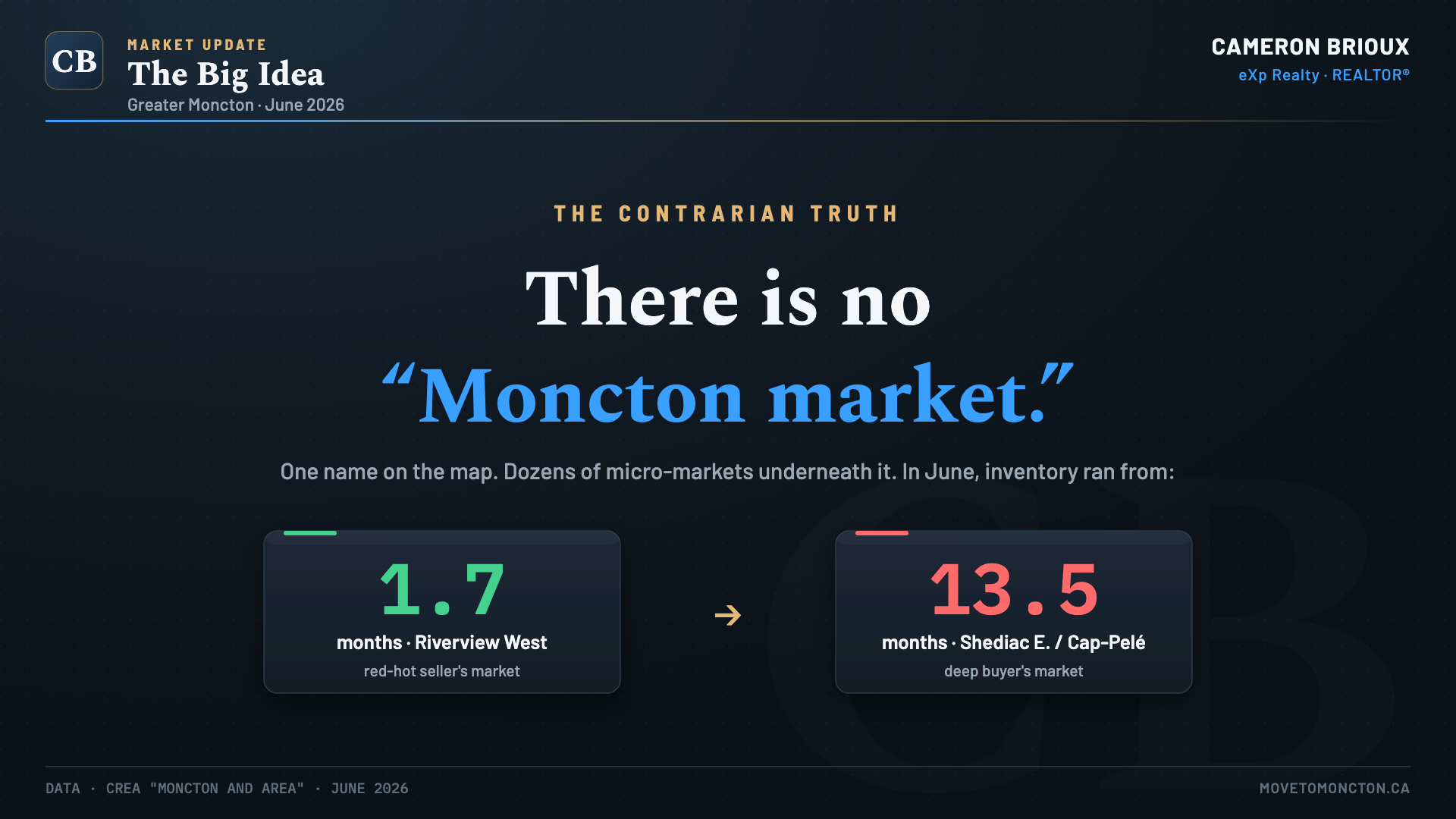
Two sellers, same month. In Riverview West, one had just 1.7 months of inventory and buyers competing for the home. Twenty-five minutes down the road in Shediac East, another had 13.5 months of inventory and a quiet phone. Same region on the sign. Nothing alike about them. Two completely different worlds.
First, how do you actually read a housing market?
Before we look at a single price, here's the lens, because the lens is the whole game. Three questions, in this order.
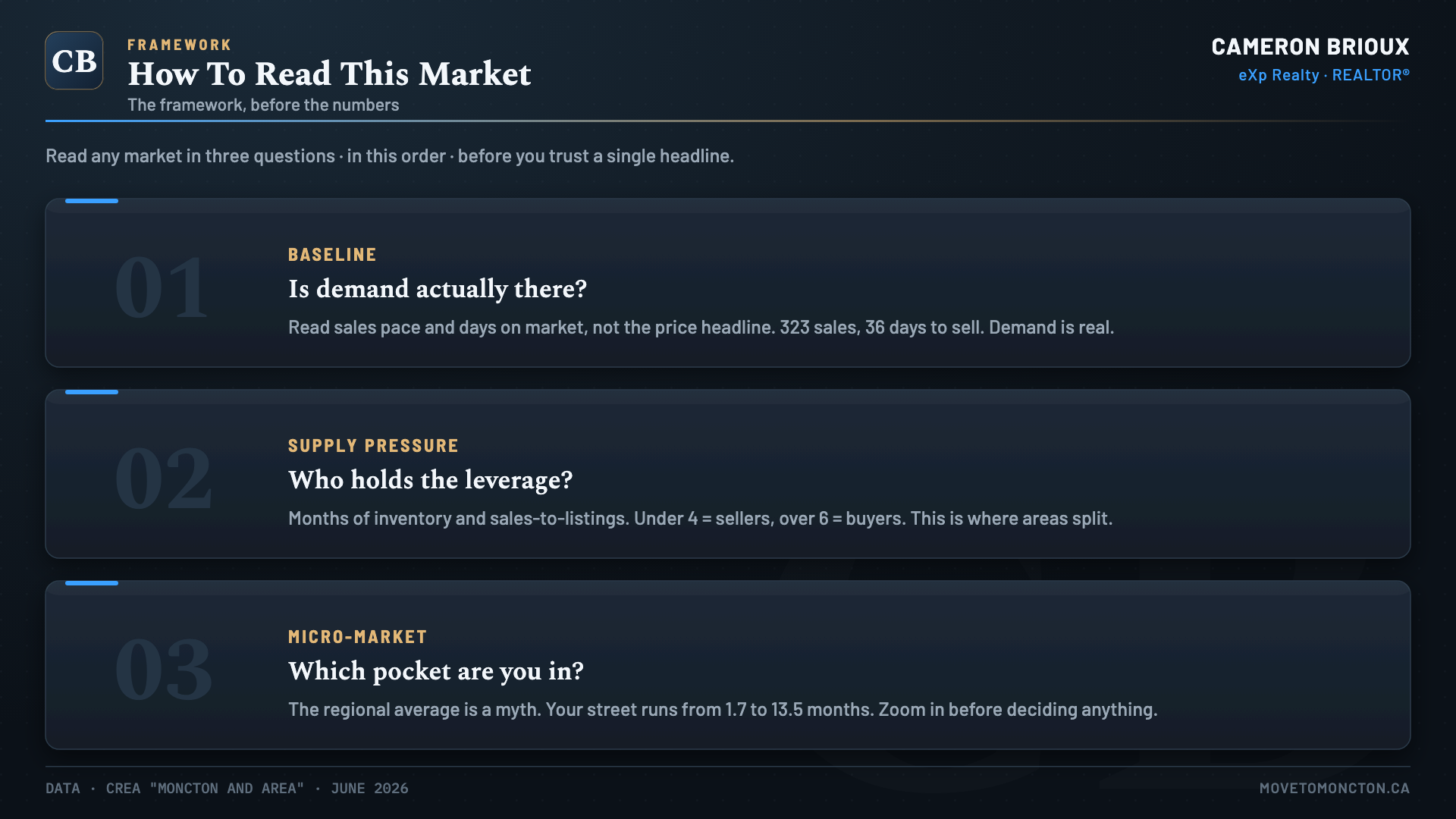
Question one is baseline: is the demand actually there? You answer that with how fast homes sell and how many change hands, not with a price headline.
Question two is supply pressure: who holds the leverage? That comes from two numbers, months of inventory and the sales-to-new-listings ratio. Under four months, sellers are in control. Over six, buyers are.
And question three, the one almost nobody asks, is the micro-market question: which small pocket are you actually standing in? Because the regional average blends together neighbourhoods that have nothing to do with each other, and that blend tells you almost nothing about your own front door. That third question is where we're spending most of our time today.
"Wait, aren't Moncton prices dropping?"
Here's the story you might be hearing at the water cooler: prices are dropping. And honestly? Whoever told you that isn't entirely wrong. The benchmark price for a typical home across the region did slip about 5 percent from the month before. So let me be straight with you about that number instead of pretending it didn't happen.
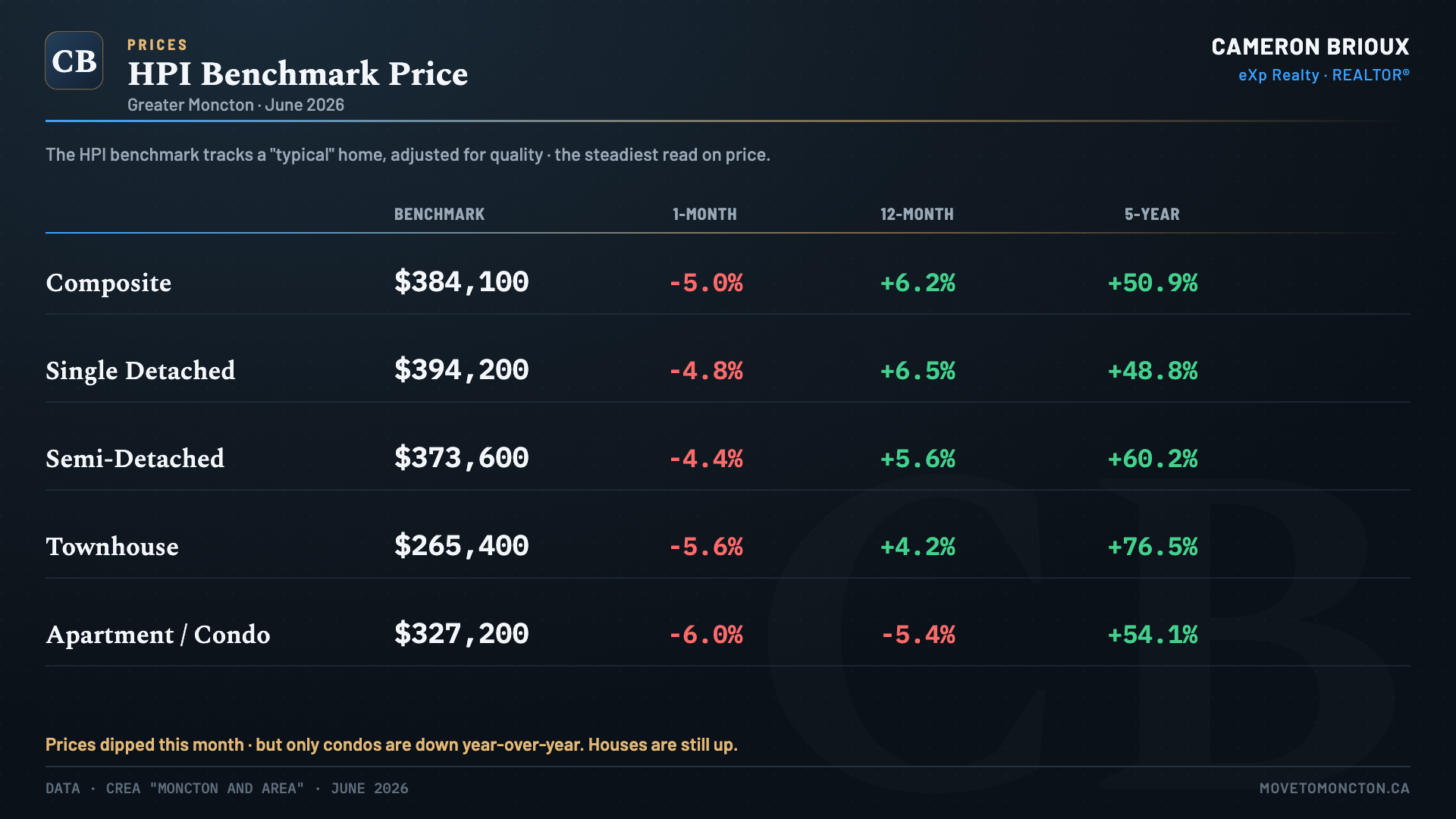
The CREA benchmark tracks a "typical" home across Canadian neighbourhoods and property types. Might not be perfect, but it's what we're working with here. Yes, month to month it came down. But that same benchmark is still up 6 percent year over year, and up more than 50 percent over five years. Homes are still selling in about 36 days, and sellers are still getting 97 cents on every dollar they ask. A one-month wobble in a region that sold 323 homes is noise, not a trend.
And here's the part that "prices are dropping" story leaves out. When you break the benchmark apart by property type, every kind of home is up year over year except one. Apartments, which honestly deserve their own video, and that's coming. Condos are down about 5 percent on the year. Detached, semis, townhouses? All still up. So the accurate version is that condo prices softened, and generally speaking, the house you're actually looking at probably didn't.
So next time you're at the water cooler, consider the source. They're probably talking about one specific house on one specific street, which is not the whole market.
What did the June 2026 numbers actually say?
Let's walk the regional dashboard quickly, and I'll lead with the number nobody talks about, because it's the one that tells the truth. Days on market. Thirty-six days, about five weeks, to sell the typical home. A decade ago that number was 77 days. So even in a month people are calling soft, homes are moving more than twice as fast as they did in 2016.
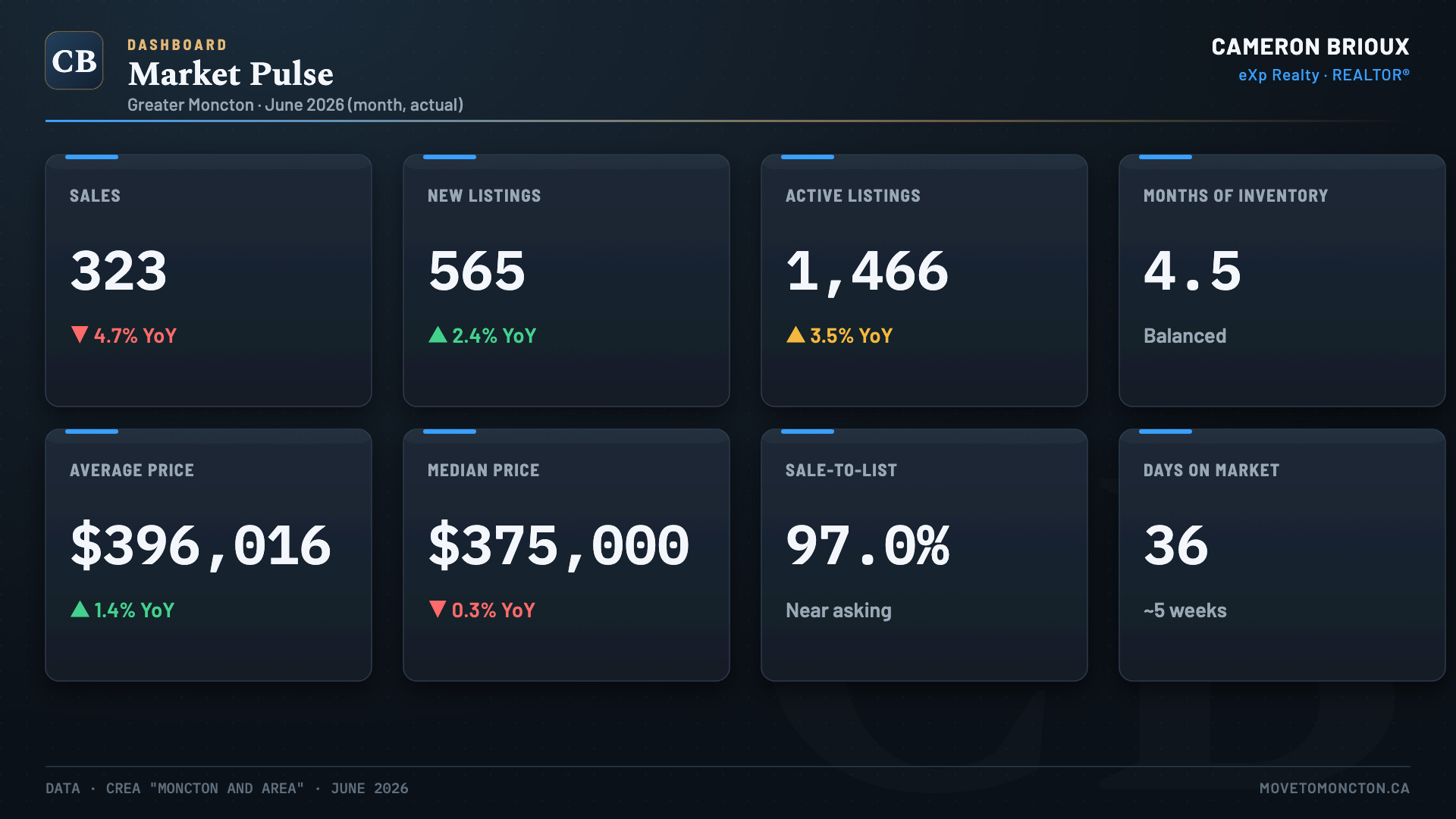
Around that, here's June for Greater Moncton. There were 323 sales, down about 5 percent from last year. Inventory rebuilt to just under 1,500 active homes. The average price, which I honestly try not to lean on, is actually up on the year. The median is basically flat, and months of inventory sits at 4.5, which lands the region as a whole in balanced territory.
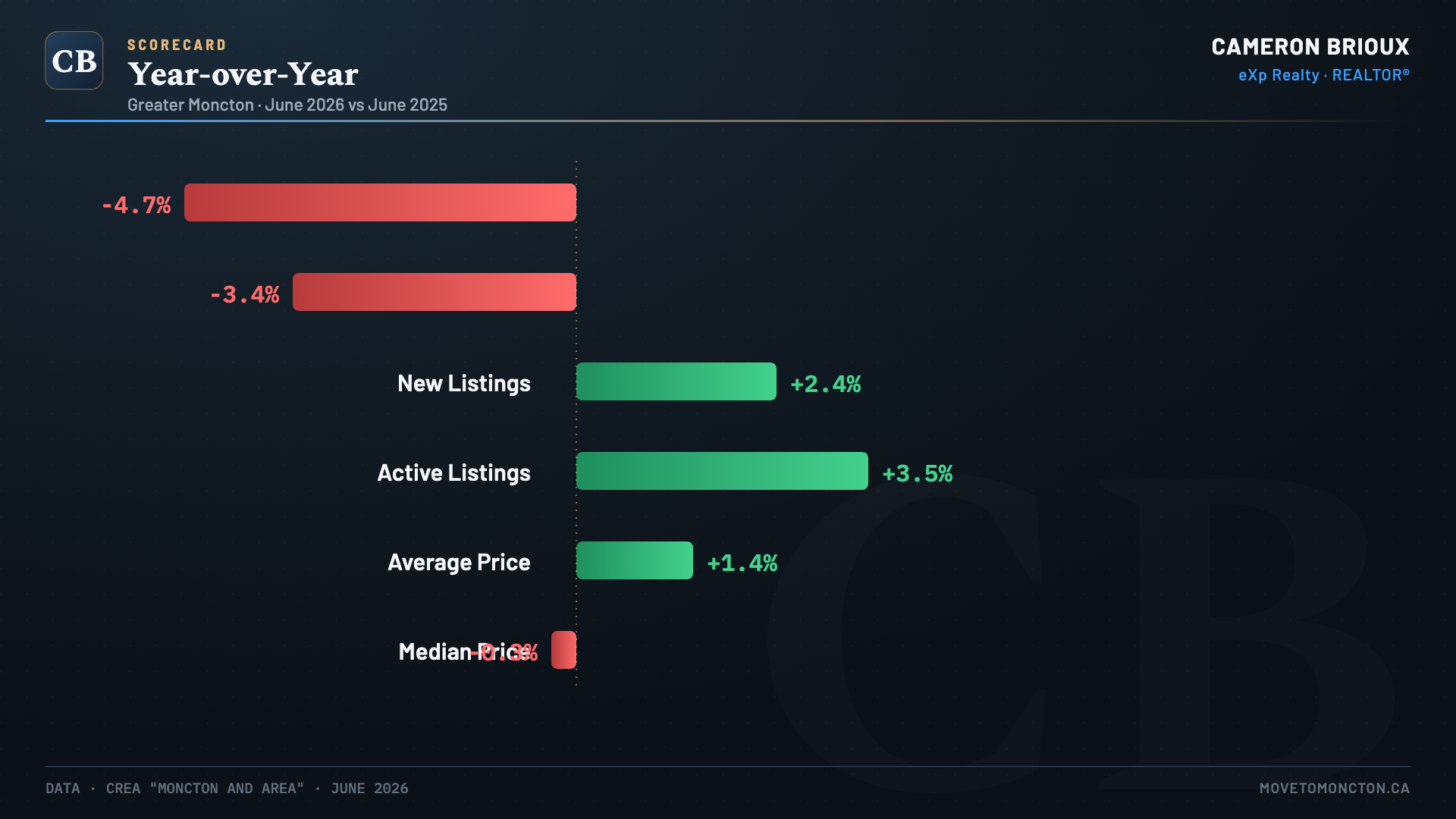
But here's the thing, and it's the entire point of this piece. That 4.5 is a number that does not exist anywhere on the ground. It's the average of a red-hot market and an ice-cold one, blended into a stat that describes neither. So let's throw the average away and look at the actual micro-markets.
A quick word on Toronto and Vancouver
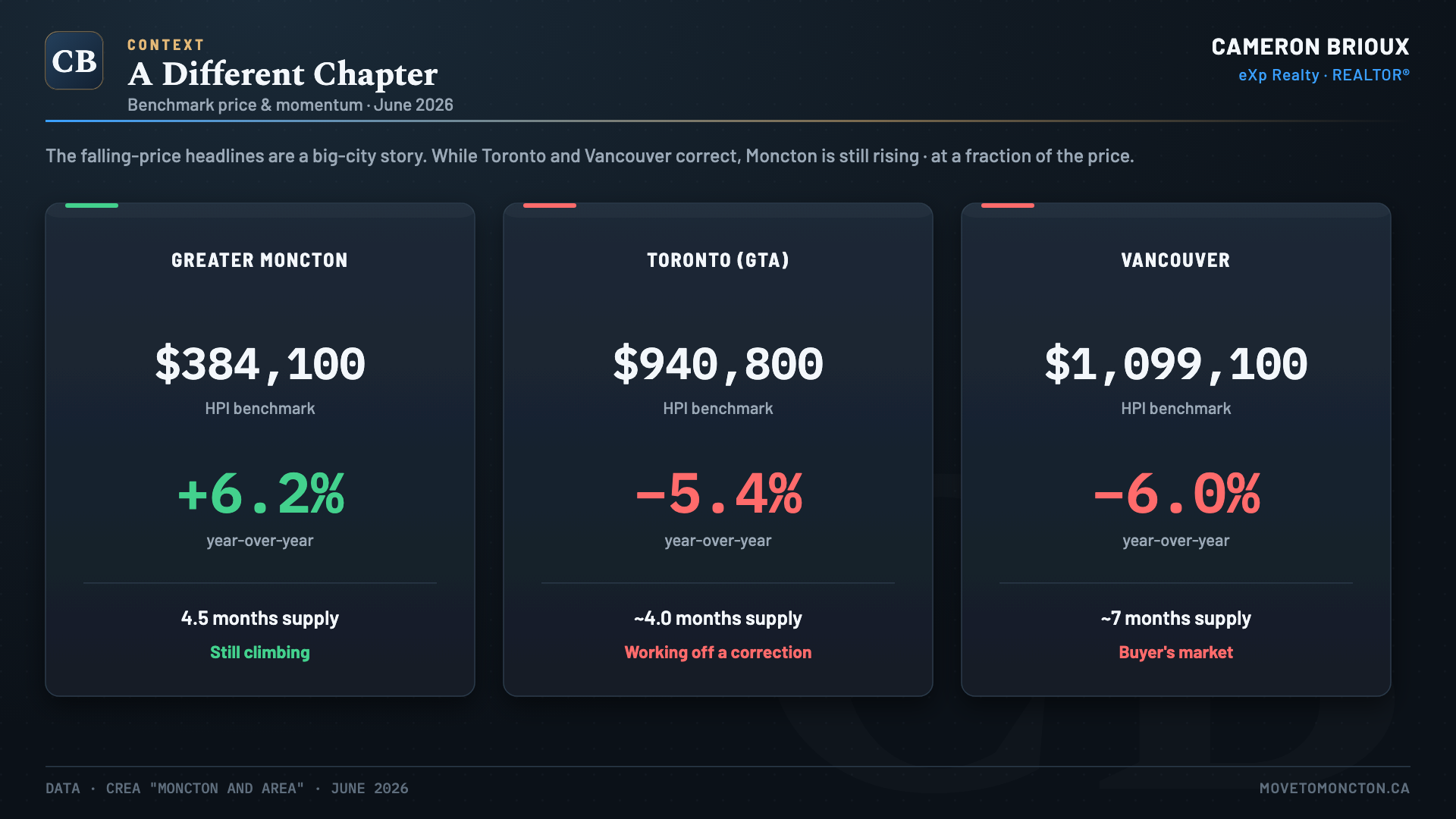
One fast note, because you'll hear it. When national headlines say prices are falling, that's usually a Toronto and Vancouver story, and we are simply not in it. Their typical homes are down 5 and 6 percent on the year and cost around a million dollars or more. Ours, Greater Moncton, is up 6 percent and costs around $384,000. That's the whole comparison. We're not them.
So why is there no single "Moncton market"?
Your friend at the water cooler started this, so let's go a little deeper and show you how close to home this actually hits. I'm going to prove the region is a patchwork by starting somewhere that should be impossible: inside a single city.
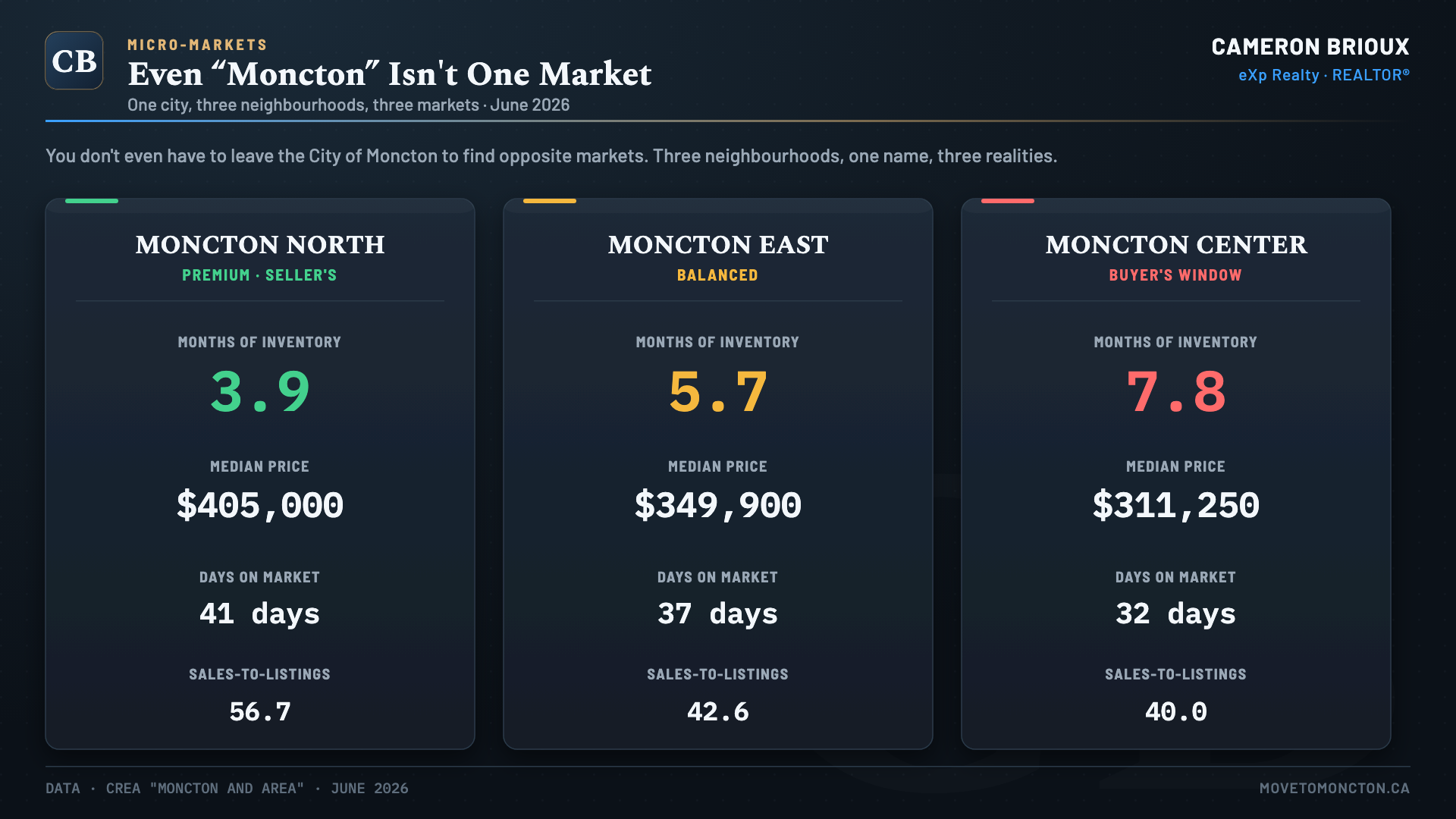
Take Greater Moncton, the area our board draws a bit wider, from the old Greater Moncton Real Estate Board footprint. One name. But in June, Moncton North had 3.9 months of inventory and a median around $405,000, and guess what? It behaved like a seller's market. Meanwhile Moncton Center, which actually includes a lot of properties and a lot of property types, had nearly 8 months of inventory and a median around $311,000, and, surprise, it behaved like a buyer's market. Moncton East sat right between them, balanced. Three neighbourhoods, one name on the map, three completely different realities. You cannot price a home in Moncton North using what happened in Moncton Center. They're not the same market. They're not even close.
Now zoom out and it fractures further. Dieppe, as a whole, was the strongest story of the month, sales up 45 percent year over year. But even Dieppe isn't one market. Fox Creek posted a median around $480,000 with homes selling in 19 days. What drives that kind of demand? Schools, property type, the age of the housing stock. A few minutes away, another Dieppe pocket was taking six weeks to sell. Same city. Different micro-markets.
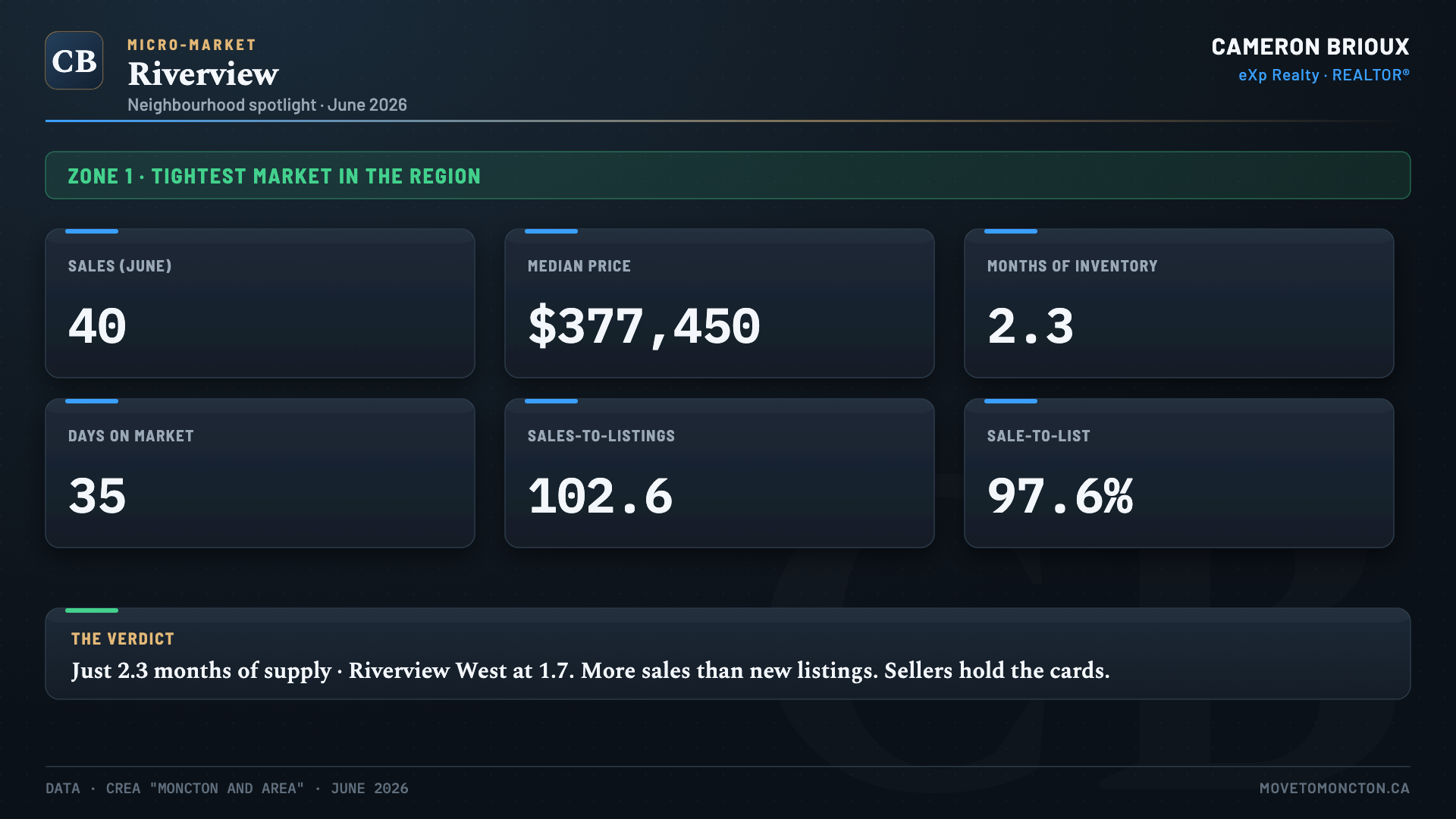
Then there's Riverview, which quietly held the single tightest micro-market in the whole region, Riverview West, the one I opened with. Just 1.7 months of inventory, homes selling in about three weeks, and more homes selling than were even newly listed. If you own in Riverview West and you're thinking of selling, understand the leverage is entirely yours right now. That's a different planet from a rural pocket like Shediac East, sitting at 13.5 months.
How do you make sense of dozens of micro-markets?
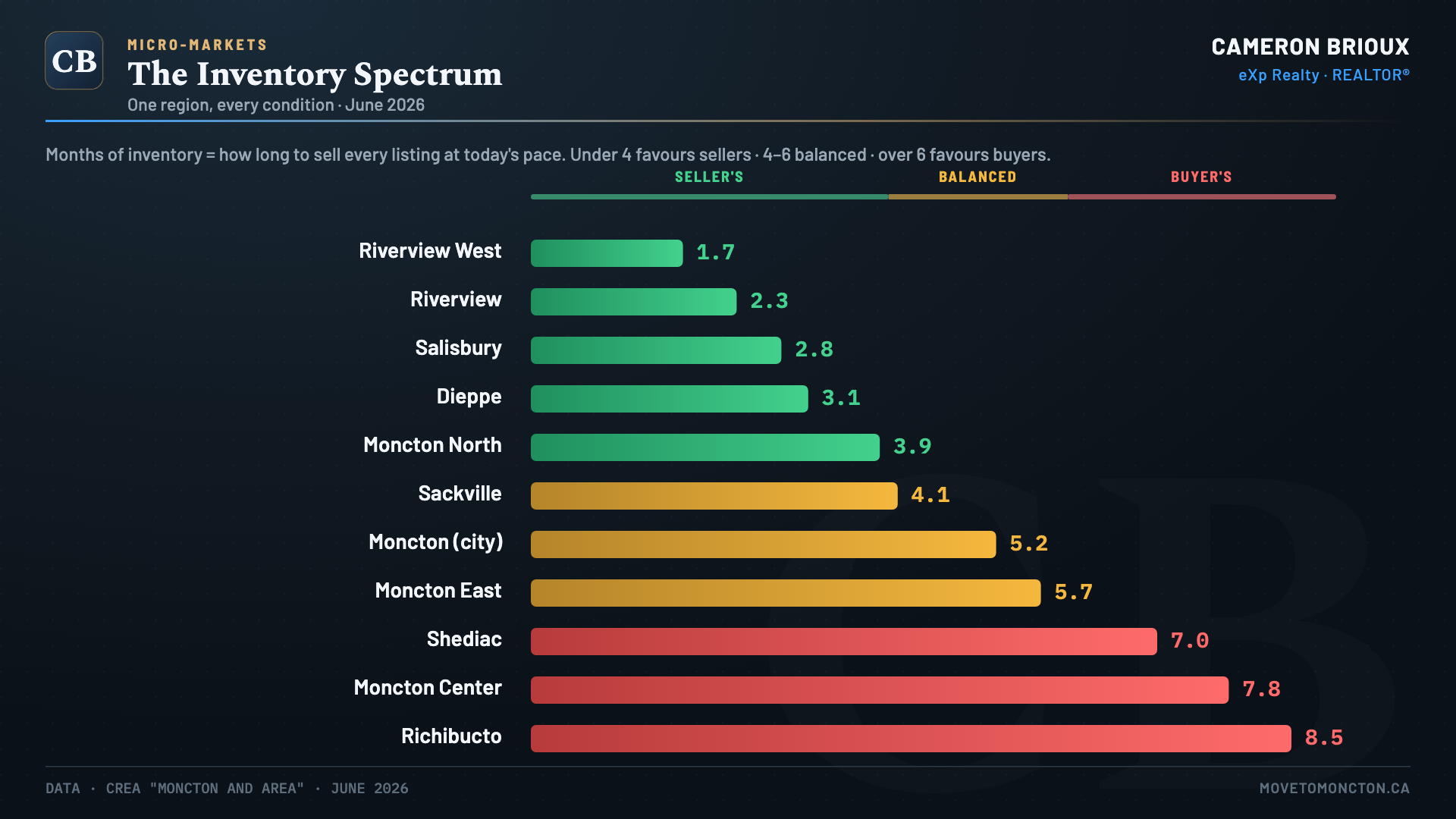
Look at that spread, 1.7 months to 13.5, in the same region, in the same month. You can't memorize thirty micro-markets, so here's how I want you to hold it: sort them into three zones. And remember, this is always changing month to month.
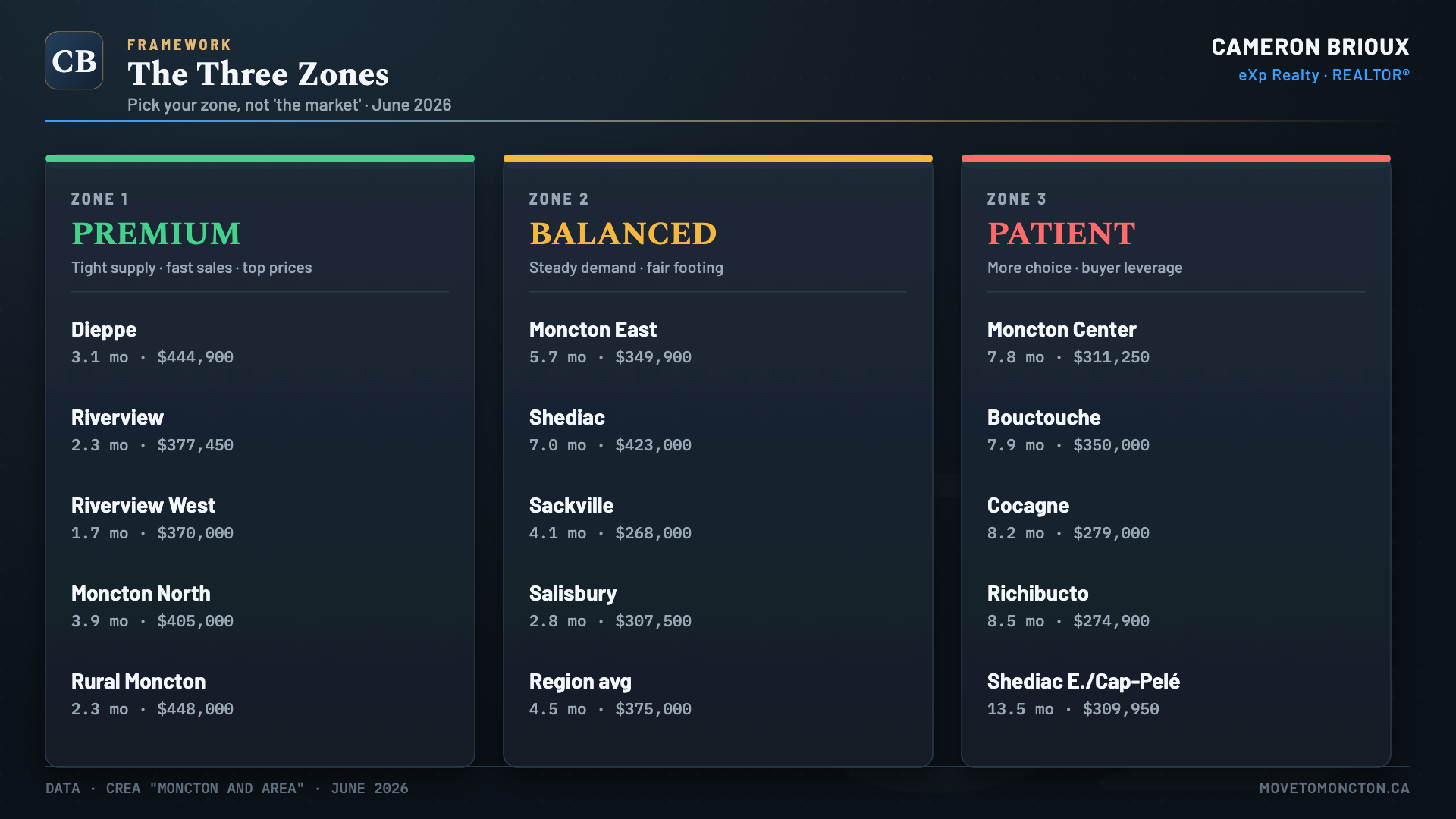
Zone one is premium, a seller's market. This month that's Dieppe, Riverview, and Moncton North. Tight supply, fast sales, top prices, near-asking offers.
Zone two is balanced, much of Moncton East, Shediac, Sackville, Salisbury, fair footing on both sides, where deals come together when the price is honest.
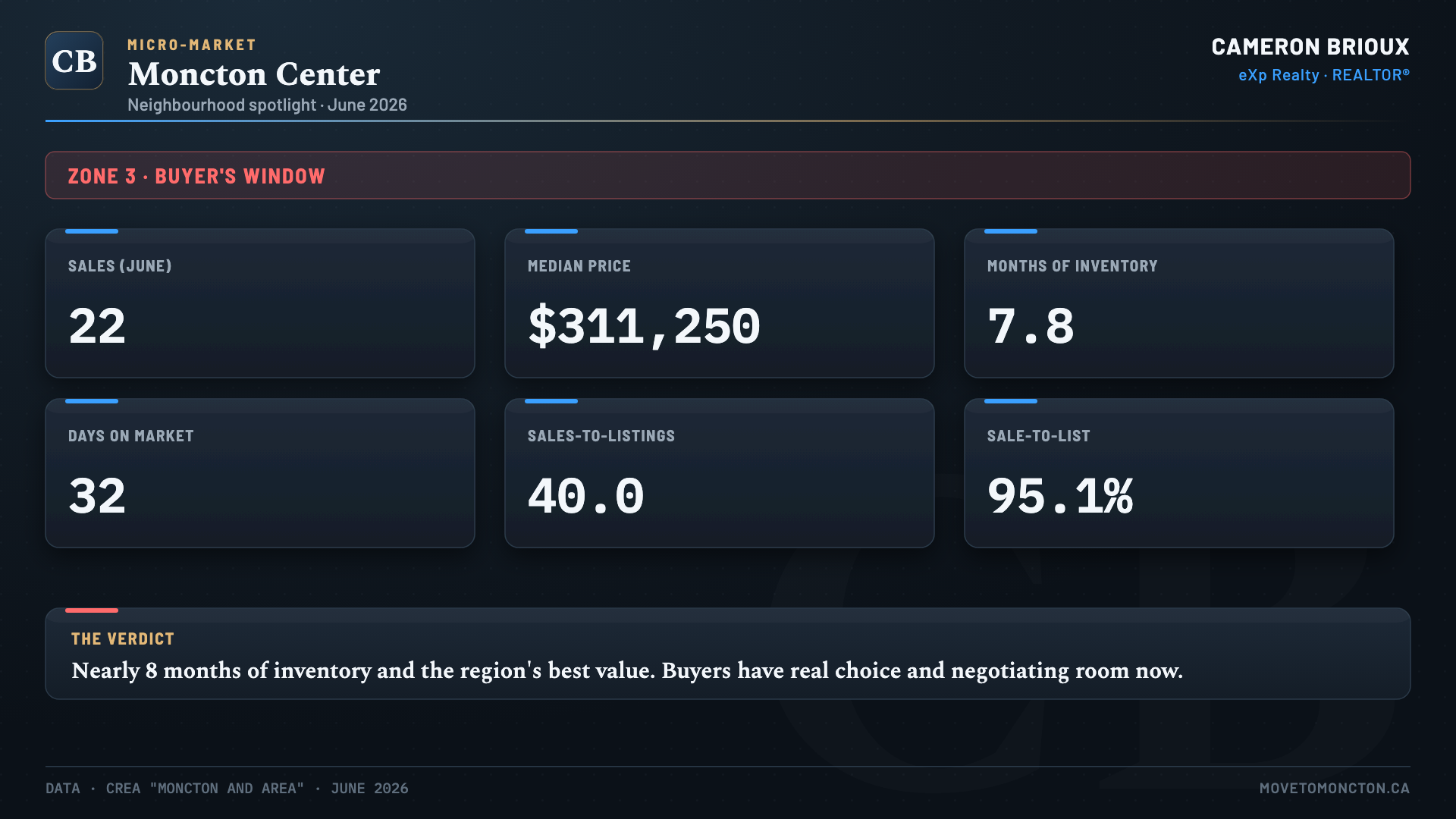
Zone three is the patient zone, where buyers finally have room to breathe. Moncton Center, with nearly 8 months of inventory and the best value in the region, plus the rural edges going further still. If you're a buyer, this is where you have choice, time, and possibly real negotiating power. If you're a seller here, you're competing, and your price has to be right. This is exactly where you want a REALTOR who'll break down and show you the data, not sell you a crystal ball.
Should you buy or sell in Greater Moncton right now?
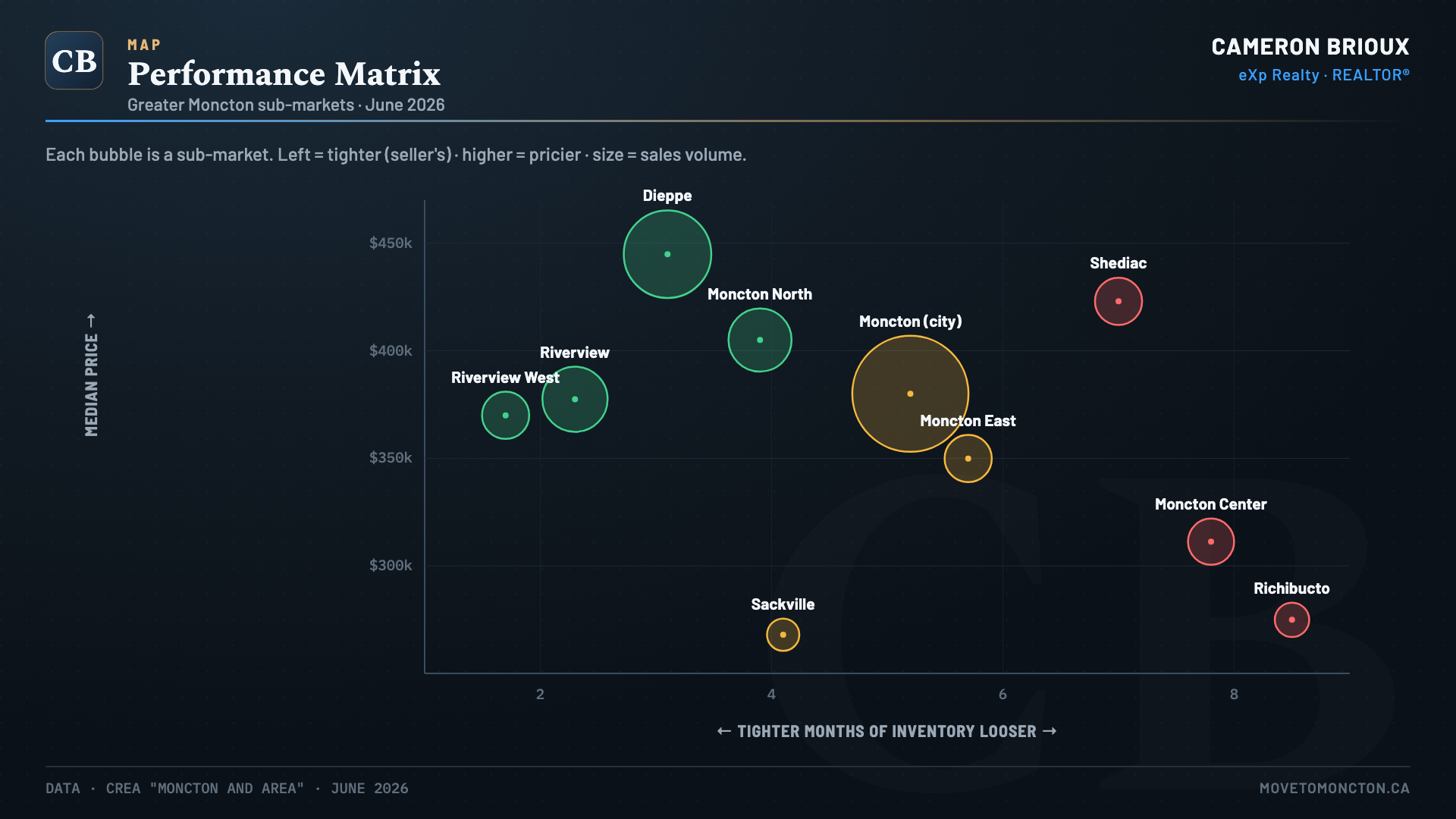
If you're a seller, the first job is to find your micro-market before you price anything, because a Riverview West strategy will fail in Moncton Center, and the reverse leaves money on the table. My pro tip: price to today's comparable sales in your own pocket, not to what your neighbour got in 2022, and definitely not to a regional average that describes nowhere. And factor in the condition of your home. I could go on, but I've got a whole video on that. If you're in a zone-one micro-market, move with confidence, because the leverage is real, but your pricing still needs to be on point.
If you're a buyer, stop waiting for a regional crash the data simply is not showing. Prices are up year over year and homes still sell in five weeks. Instead, aim at zone three, where the inventory actually is, and use the leverage that genuinely exists in those pockets. And if you want a condo, that's the one place time is on your side this year.
If you're just watching, carry this forward, or send it to a friend who needs to hear it. Never accept a regional average as your answer. Always ask which micro-market, and always separate the one-month noise from the year-over-year signal.
Greater Moncton real estate: your questions, answered
Is now a good time to sell a house in Greater Moncton?
It depends on your micro-market, not the region as a whole. In June 2026, tight pockets like Riverview West (1.7 months of inventory) and Dieppe (3.1 months) clearly favoured sellers, while Moncton Center (7.8 months) favoured buyers. Region-wide, homes still sold in about 36 days at 97 percent of asking. Find your specific pocket's numbers before you list, and price to today's comparable sales.
Is now a good time to buy in Greater Moncton?
Yes, if you target the right micro-market. Buyers have the most leverage in higher-inventory pockets like Moncton Center (nearly 8 months of supply) and the rural edges, where there is choice and room to negotiate. Condos are also softer, down about 5 percent year over year. Tighter areas like Riverview and Dieppe still favour sellers.
Is the Moncton housing market crashing in 2026?
No. The benchmark price for a typical home dipped about 5 percent from the previous month in June 2026, but it is still up 6 percent year over year and more than 50 percent over five years. Homes sold in about 36 days at 97 percent of asking. A single month's move is noise, not a crash.
What is the average home price in Greater Moncton in 2026?
In June 2026, the average sale price was $396,016 and the median was $375,000. The MLS HPI benchmark, a quality-adjusted 'typical' home, was $384,100, up 6.2 percent year over year.
Is it a buyer's or seller's market in Greater Moncton?
Both, depending on where you look. Region-wide inventory was 4.5 months in June 2026, which is balanced, but it ranged from 1.7 months in Riverview West (a strong seller's market) to 13.5 months in Shediac East (a buyer's market).
What is the best neighbourhood to buy in Greater Moncton?
There is no single answer; it depends on your goal. For demand and resale strength, Dieppe led in June 2026 with sales up 45 percent year over year. For value and buyer leverage, Moncton Center had the region's best pricing. Riverview West was the fastest-moving pocket.
Where can I find the best value or deals in Moncton?
Moncton Center offered the best value in June 2026, with a median around $311,250 and nearly 8 months of inventory, which gives buyers real negotiating room. Rural pockets and the condo segment were also softer.
Where should I downsize in Greater Moncton?
Downsizers usually benefit most in buyer-friendly pockets and the condo segment, both softer in June 2026. Moncton Center offered the most inventory and the best value, and apartment prices were down about 5 percent year over year, giving downsizing buyers more choice. Condo trends move fast, so talk to a REALTOR about your specific plan before you commit.
How long does it take to sell a house in Greater Moncton?
In June 2026, the typical home sold in about 36 days, roughly five weeks, down from 77 days a decade earlier. Faster micro-markets like Riverview West and Dieppe's Fox Creek moved in about three weeks.
How is the Moncton condo market?
Softer than houses. Apartments and condos were the only property type down year over year in June 2026, off about 5 percent, which makes it the most buyer-friendly segment. Detached, semi-detached, and townhouse prices were all up on the year.
Which micro-market is your neighbourhood in?
Tell me your neighbourhood and I'll tell you exactly which zone it's in, and what that means if you're thinking of buying or selling. Every street in Greater Moncton is telling a different story this year. Let's figure out yours.
All Greater Moncton figures are sourced from the Canadian Real Estate Association's MLS® Residential Market Activity and Home Price Index Report, "Moncton and Area," June 2026. Toronto figures from the Toronto Regional Real Estate Board and Vancouver figures from Greater Vancouver Realtors, June 2026 releases. This article is general market commentary and not financial, investment, or legal advice. Cameron Brioux, eXp Realty, REALTOR®.