Anyone telling you otherwise is trying to sell you something or has not really taken a look at the data. Here is the real story behind Moncton, Dieppe, and Riverview home prices in May 2026.
If you are a buyer, a seller, or just someone who owns a home in Greater Moncton and wants to know what your biggest asset is doing right now, the goal of this update is to change how you read real estate headlines for the rest of the year.
Today, we are going to walk through exactly what is happening in this market right now, why the headlines are getting it completely wrong, and the framework I use every single month to cut through the noise.
The Water Cooler Is Not a Data Source
I want to address something before we get into the numbers, because it is the single biggest thing that derails good real estate decisions.
The water cooler.
You know what I am talking about. You are at work, or at a family dinner, or at a kids' hockey game, and someone says, "Oh, the market is really bad right now." Or, "My neighbour just listed and got three offers." Or, "I heard prices are going to drop another 20 percent." And suddenly that becomes your data point. That becomes the thing you are making a $400,000 decision based on.
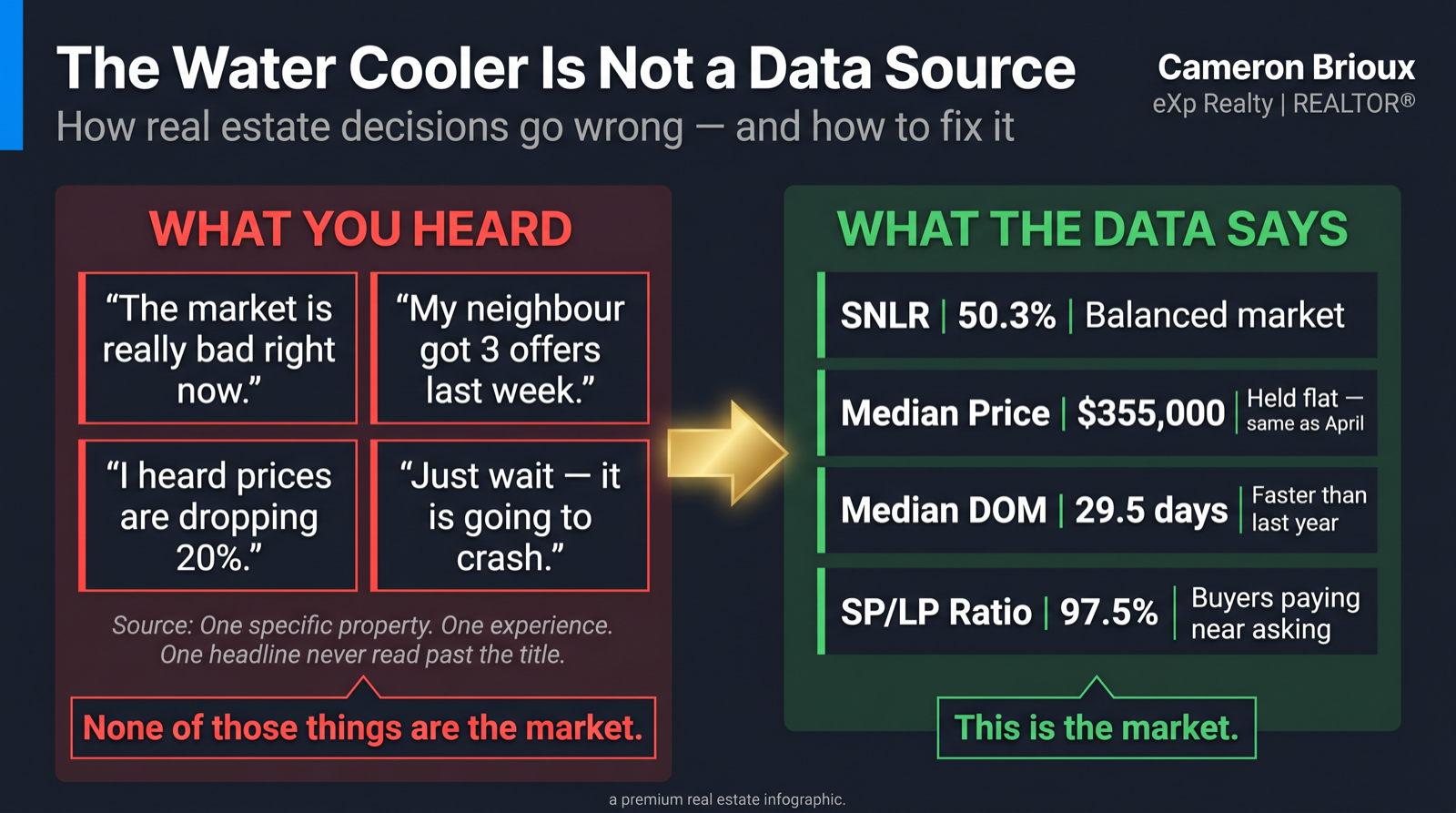
Here is the thing about water cooler real estate conversations. They are almost always based on one specific property, one specific experience, or something someone read in a headline without clicking through to the actual data. None of those things are the market.
And here is the one that I hear constantly, and I want to be honest with you about it. "My neighbour got multiple offers three years ago without even painting, and they needed a new roof."
Yes. That happened. It absolutely happened. I was there. I watched it happen. And I am not going to pretend it did not.
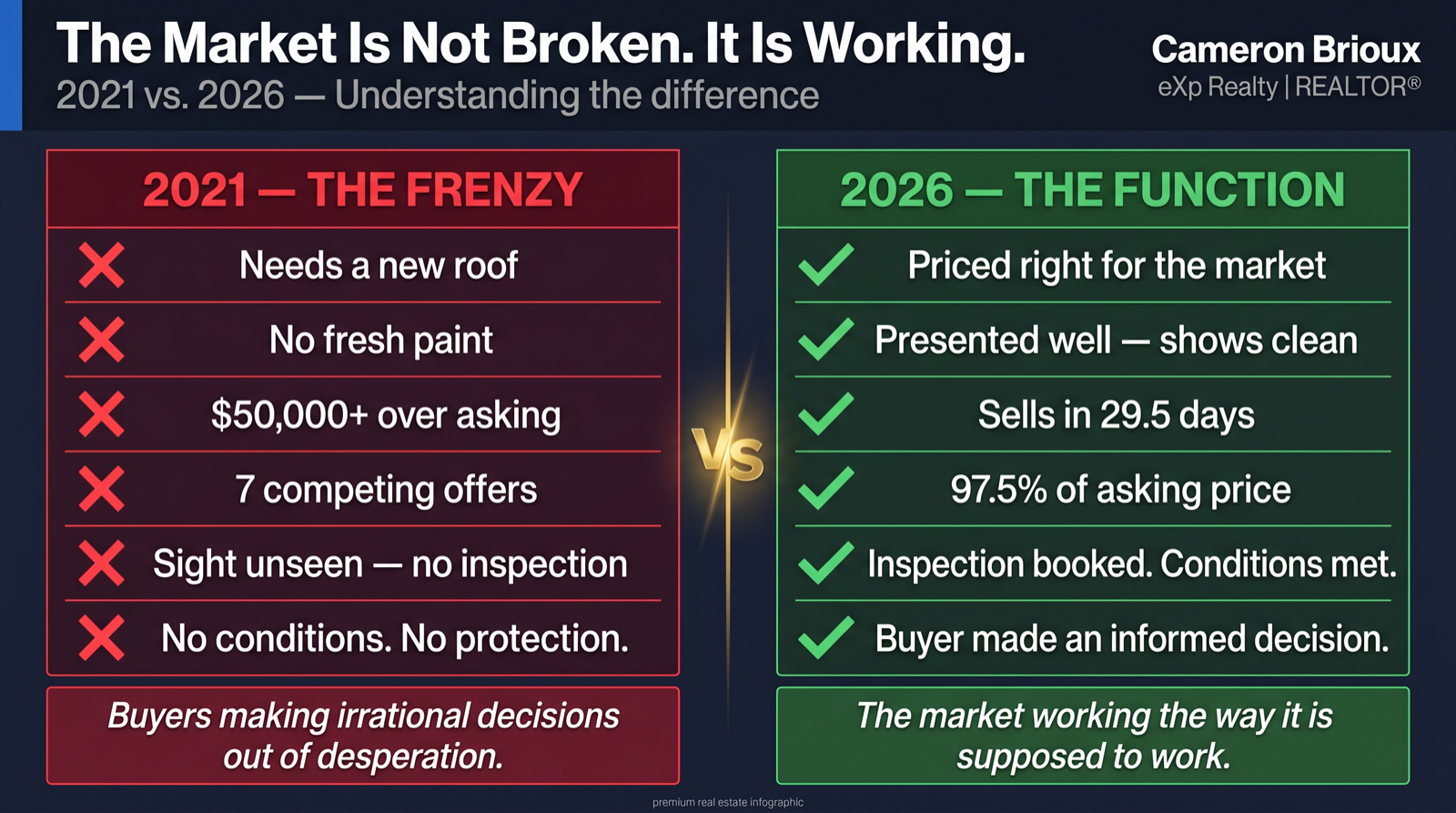
But here is what that story is actually telling you. That story is telling you that in 2021 and 2022, the market was so starved of supply and so flooded with demand that buyers were making irrational decisions out of desperation. They were paying premiums for homes that, by any objective measure, did not deserve those premiums. A home with a failing roof and no fresh paint should not sell for $50,000 over asking. But it did. Because the alternative was losing the house to someone else who was even more desperate.
That was not the market working correctly. That was the market malfunctioning.
And now, when that same home sits for 45 days because buyers have options and they are doing inspections and they are negotiating, people call that a crash. It is not a crash. It is the market working the way it is supposed to work.
The Baseline: Down Compared to What?
When you hear that sales are down 19.8 percent year-over-year in Greater Moncton, the natural reaction is to think that is bad. But down compared to what?
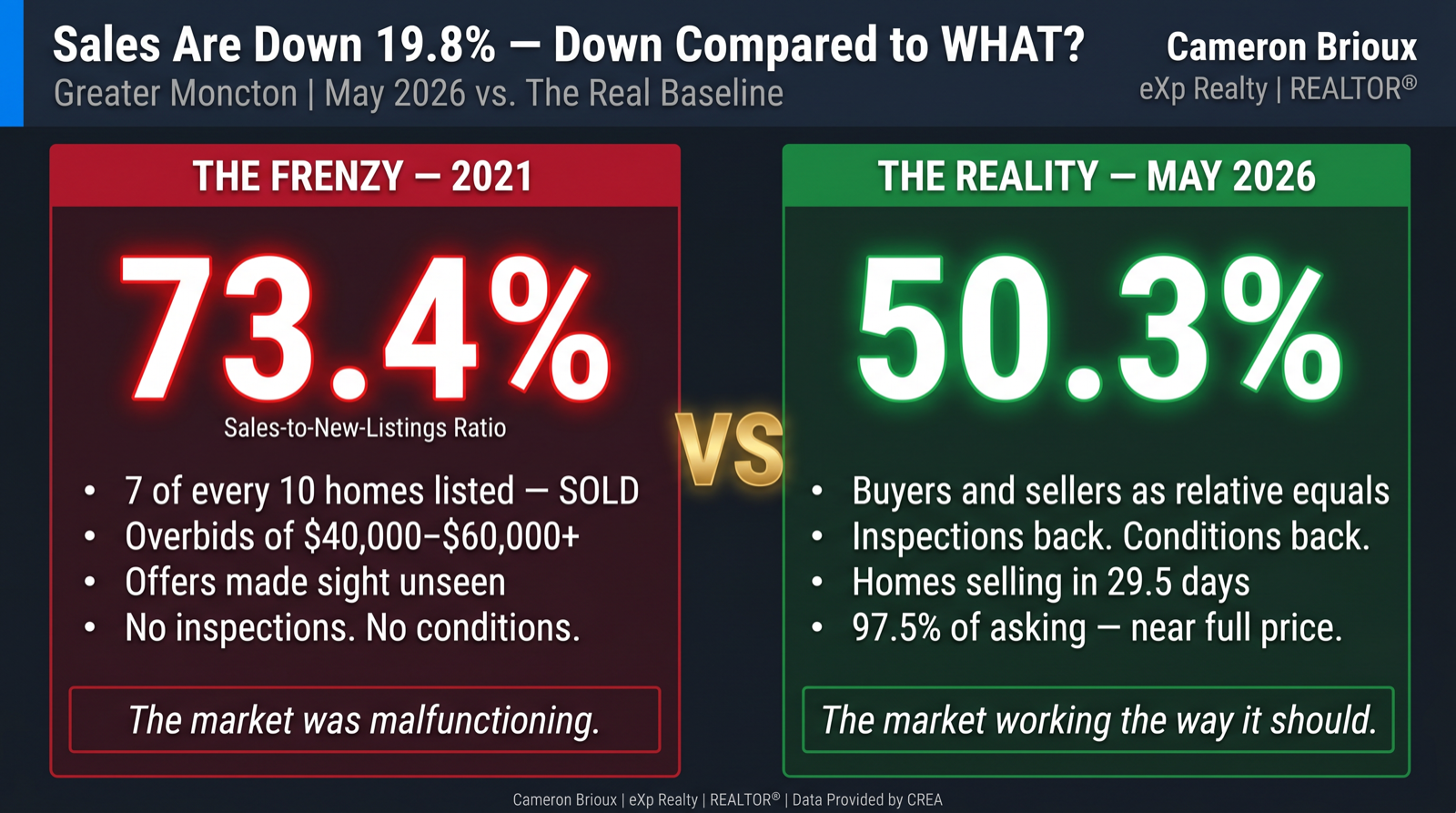
In 2021, the Greater Moncton market was running at a Sales-to-New-Listings Ratio of 73.4 percent. That means for every ten homes listed, over seven sold. That is not a market. That is a feeding frenzy. Buyers were waiving inspections. They were overbidding by $40,000 to $60,000. They were making offers sight unseen. That was the baseline we are being compared to.
So when someone tells you sales are down nearly 20 percent, they are technically correct. But they are comparing today's healthy, functional market to one of the most unsustainable periods in the history of Canadian real estate. That is not analysis. That is a headline.
How Moncton Compares to the Rest of Canada
When you hear national real estate news, you are mostly hearing about Ontario and British Columbia. Toronto. Vancouver. The GTA. And those markets are genuinely struggling in ways that our market is not.
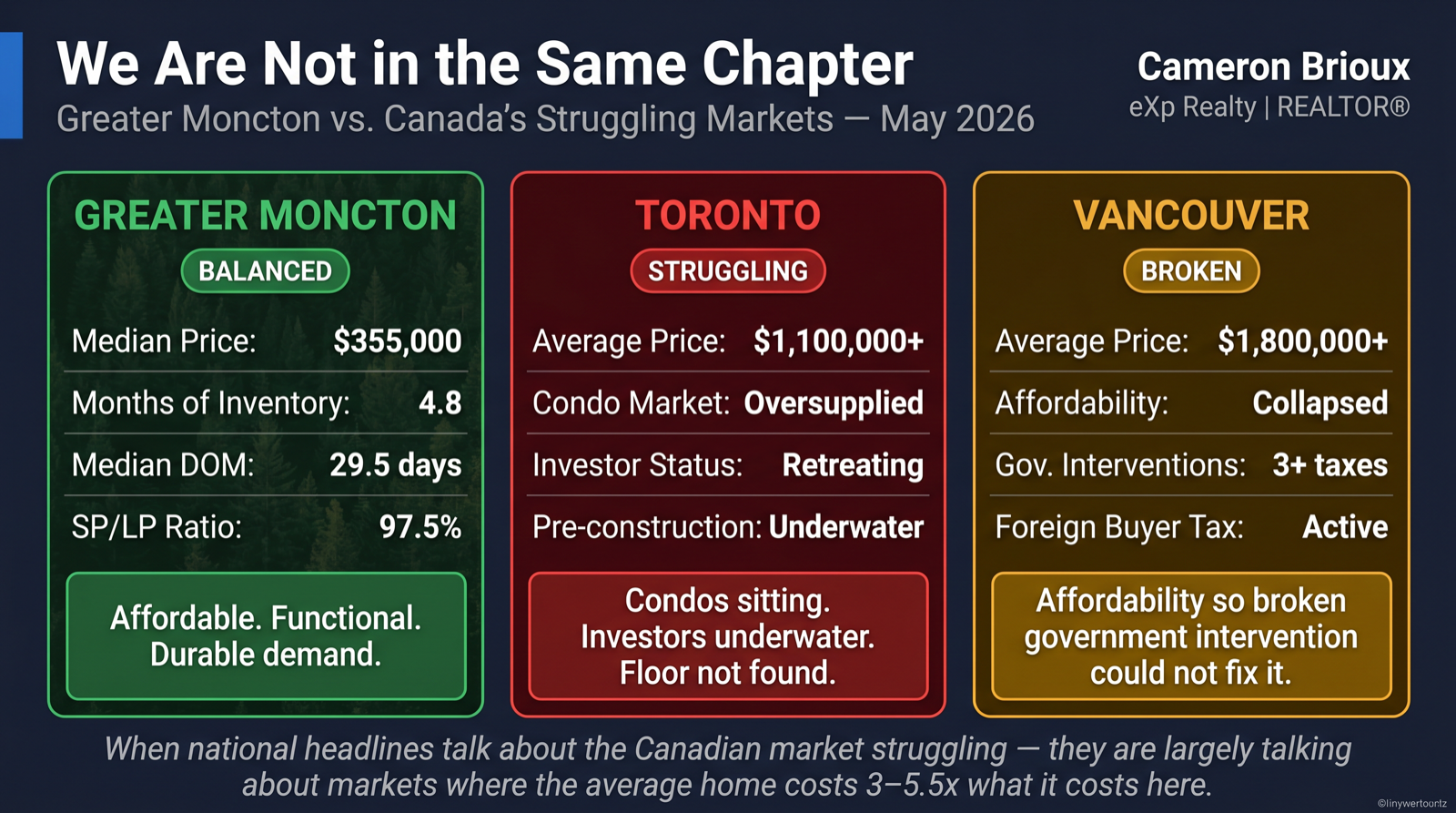
In Toronto right now, the average home price is significantly more than ours. Active inventory is at levels not seen in over a decade. Condos are sitting. Investors who bought pre-construction at peak pricing are underwater.
Now compare that to Greater Moncton. Median price: $355,000. Months of inventory: 4.8. Homes selling in under 30 days at 97.5 percent of asking price.
We are not in the same conversation. We are not even in the same chapter of the same book. When national headlines talk about the Canadian real estate market struggling, they are largely talking about markets where the average home costs three to five times what it costs here. The dynamics that are driving pain in Toronto do not exist here in the same way.
The Three Zones: Where You Live Matters
The regional average is a starting point, not a strategy. I break Greater Moncton into three distinct zones, and understanding which zone you are in changes everything about how you should approach this market.
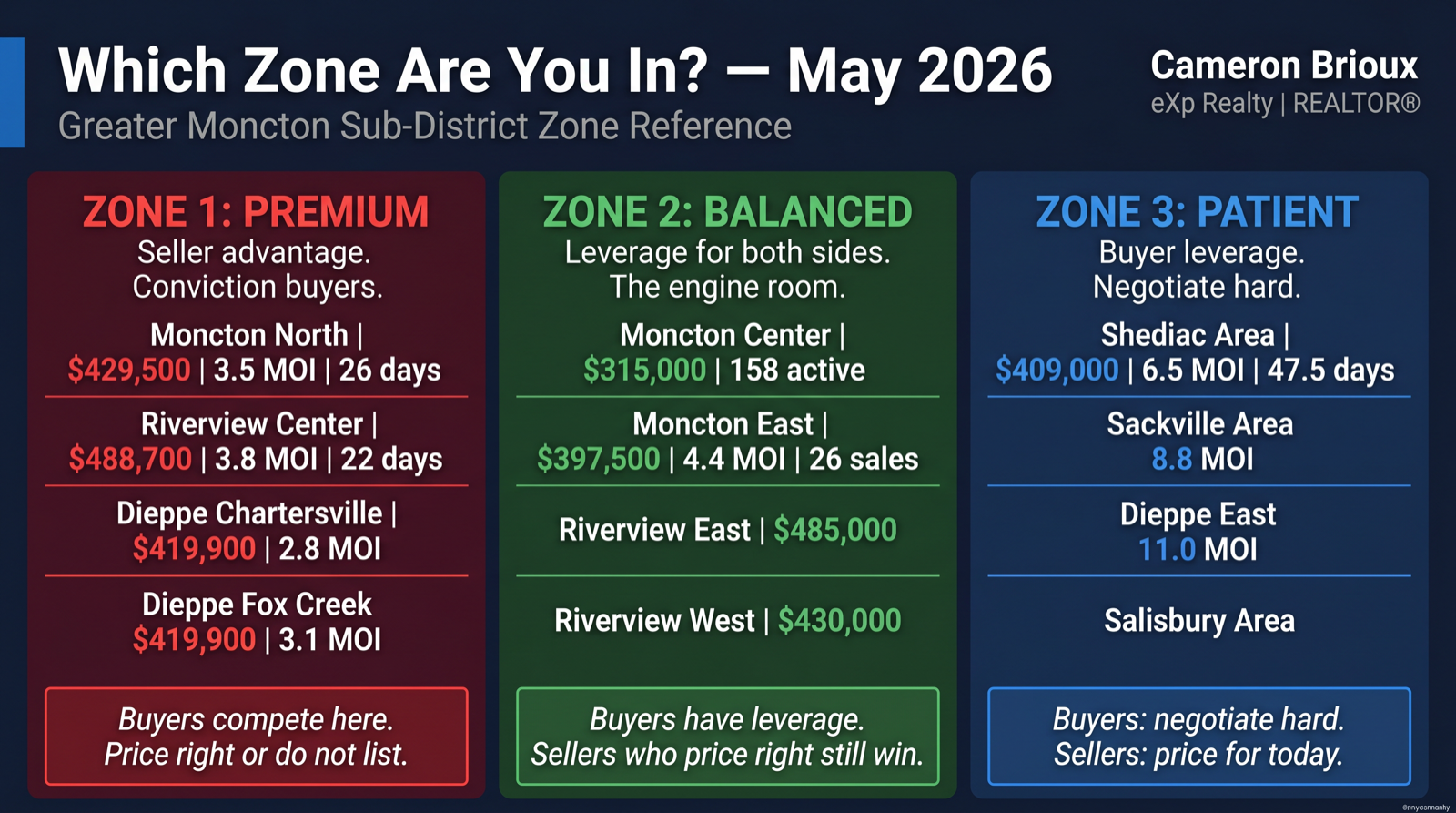
Zone 1: The Premium Markets (Moncton North)
These are areas like Moncton North, Dieppe Fox Creek, and Riverview Center. These areas are not experiencing the regional slowdown in the same way.
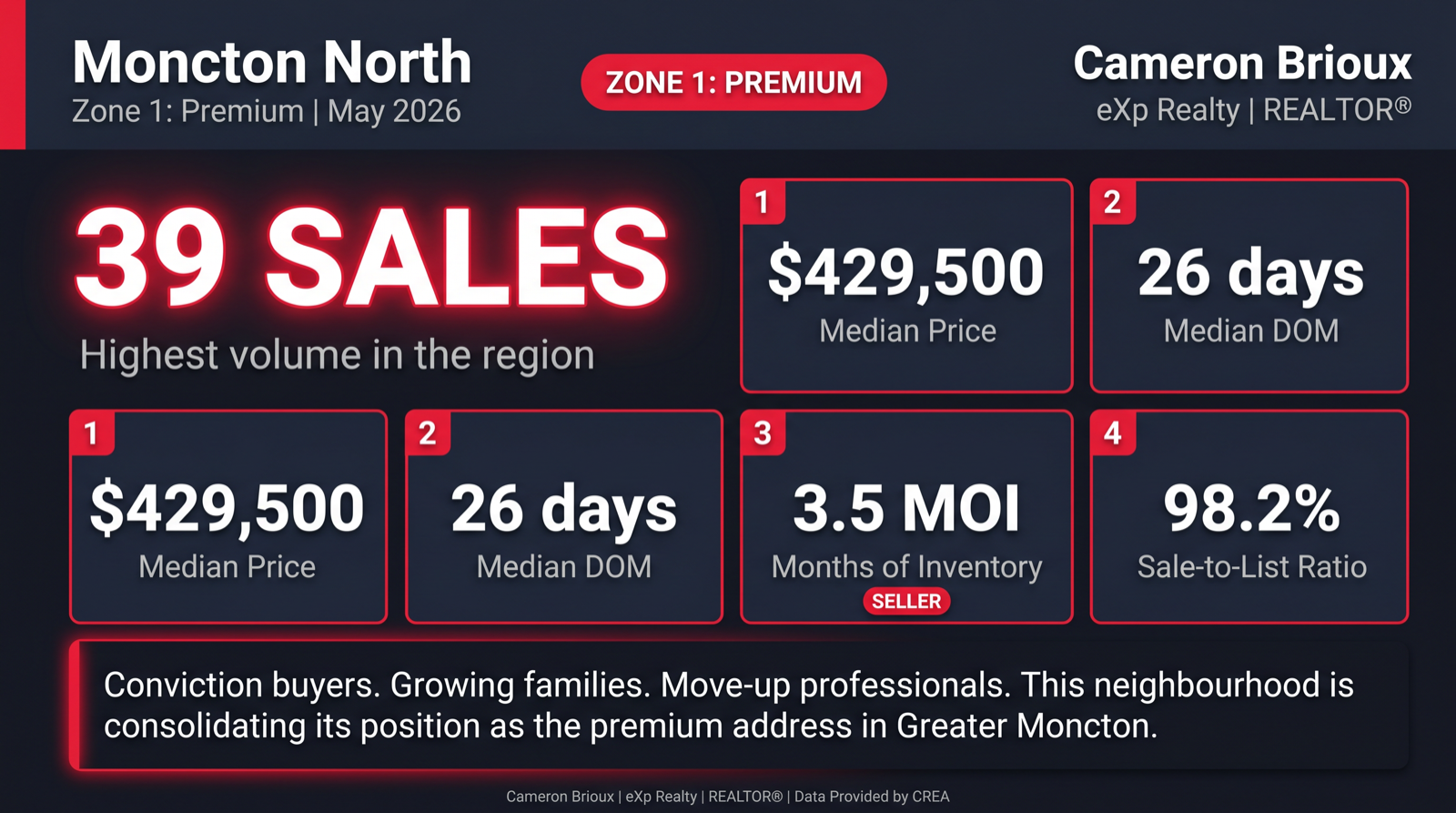
Moncton North is scaling up. This is not just a neighbourhood that is holding its value. This is a neighbourhood that is attracting a specific type of buyer - growing families, move-up buyers, professionals relocating to the region - and that buyer profile is not going anywhere. The school catchments are strong. The infrastructure is newer. The homes are larger. And the supply is limited.
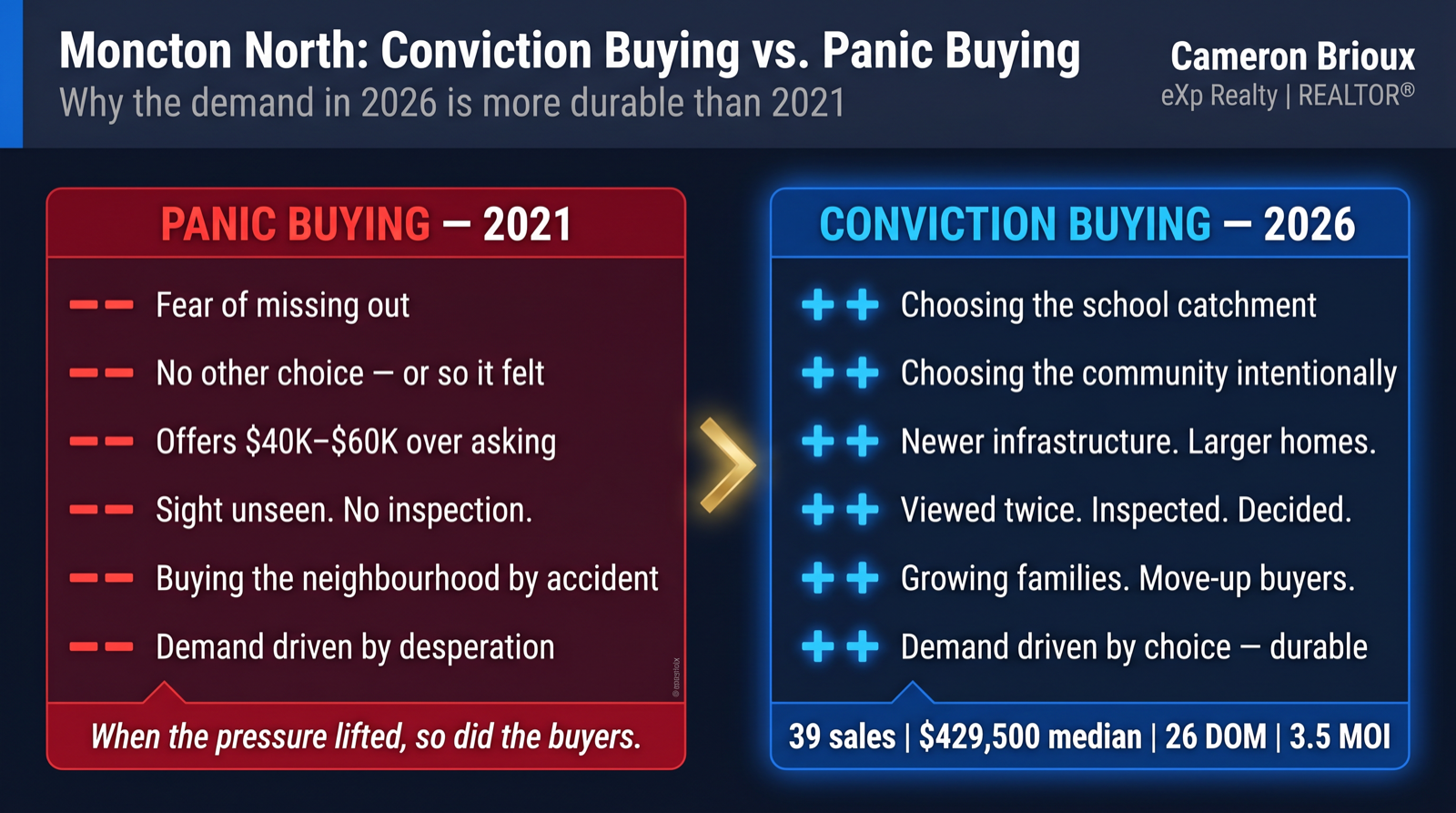
The buyers who are competing here are not doing it because they have to. They are doing it because they want to be in that specific community. That is a fundamentally different kind of demand than the panic-buying we saw in 2021. This is conviction buying. And conviction buying is durable.
Zone 2: The Balanced Core (Moncton Center & East)
This is Moncton Center, Moncton East, Riverview East, and Riverview West. These are the engine rooms of the market. Good volume. Reasonable prices. But buyers have leverage here in a way they did not two years ago.
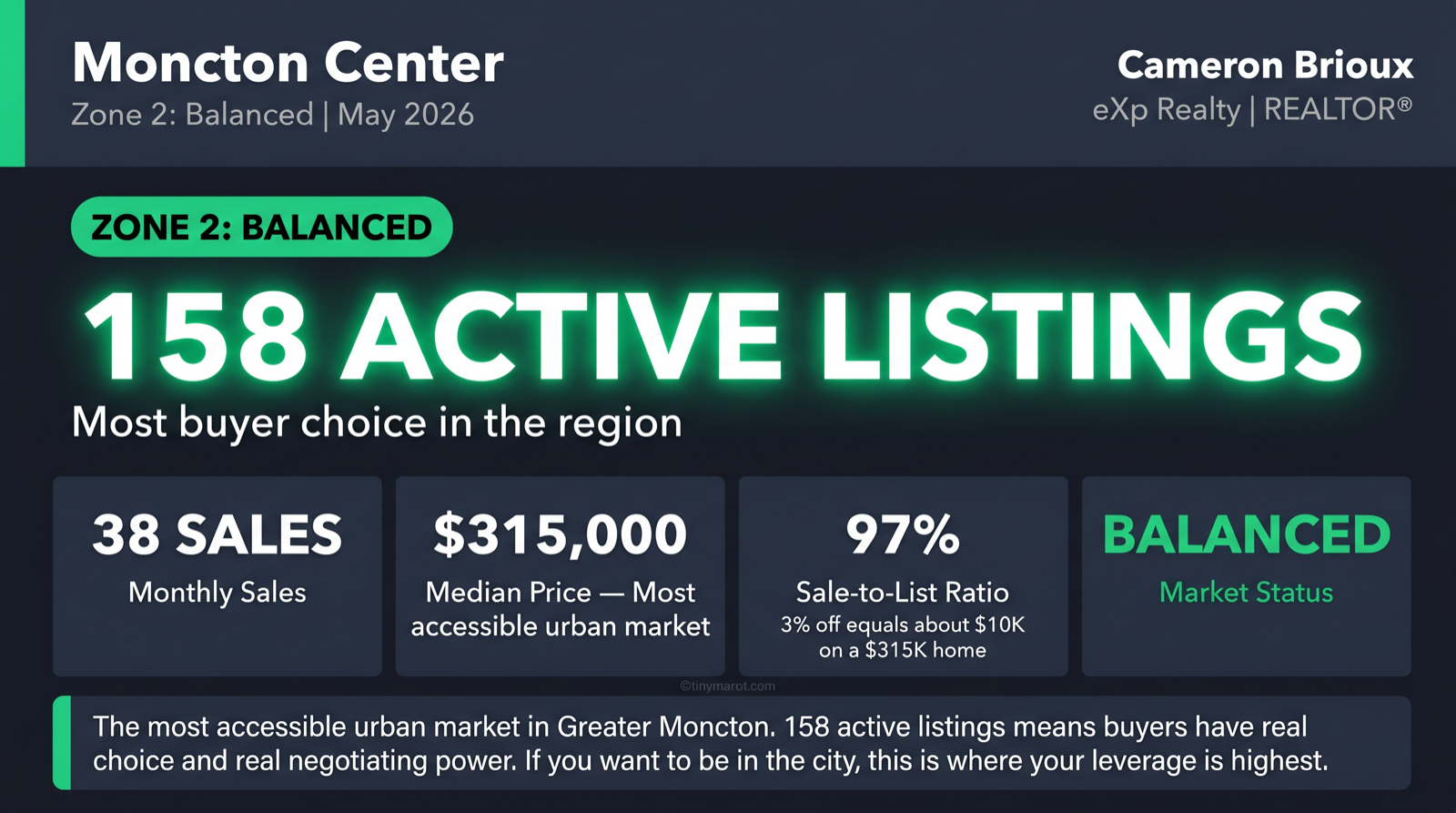
Moncton Center is the most accessible urban market in the region. With 158 active listings, it has the most choice of any sub-district. If you are a buyer and you want to be in the city, Moncton Center is where your negotiating power is highest. Buyers are getting homes at 97 percent of asking price on average. That 3 percent discount on a $315,000 home is nearly $10,000. That is real money.
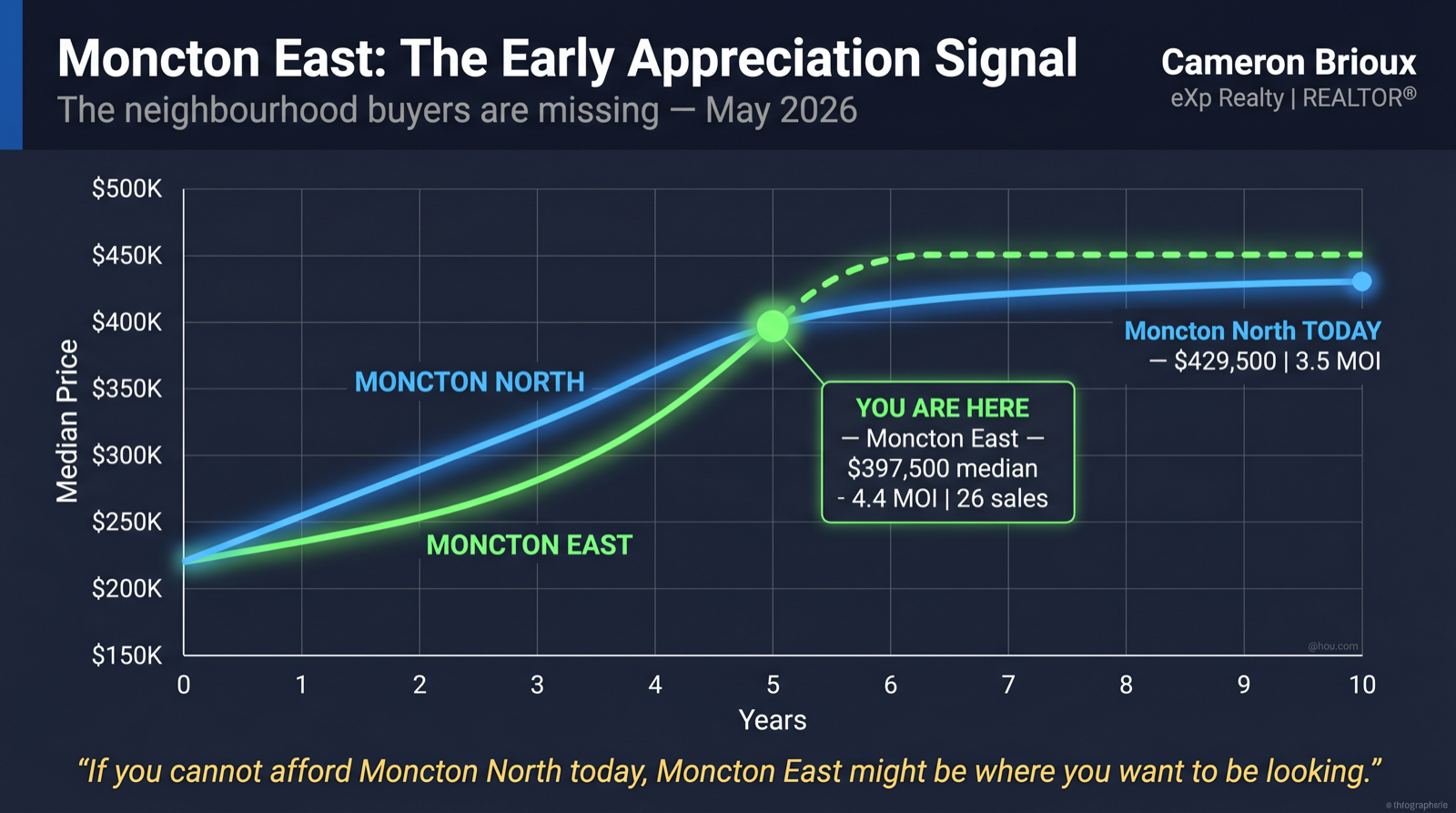
Moncton East is the one I watch most closely for what I call the appreciation signal. The sub-districts within Moncton East- the areas closer to the city core, the neighbourhoods with newer infill development- those are starting to show early signs of the kind of price appreciation that Moncton North went through five years ago. If you are a buyer who cannot afford Moncton North today, Moncton East might be where you want to be looking.
Zone 3: The Patient Markets (Shediac Area)
Shediac, Sackville, Salisbury, and Rural Dieppe. These are the areas where the regional slowdown is most visible, and where buyers have the most leverage.
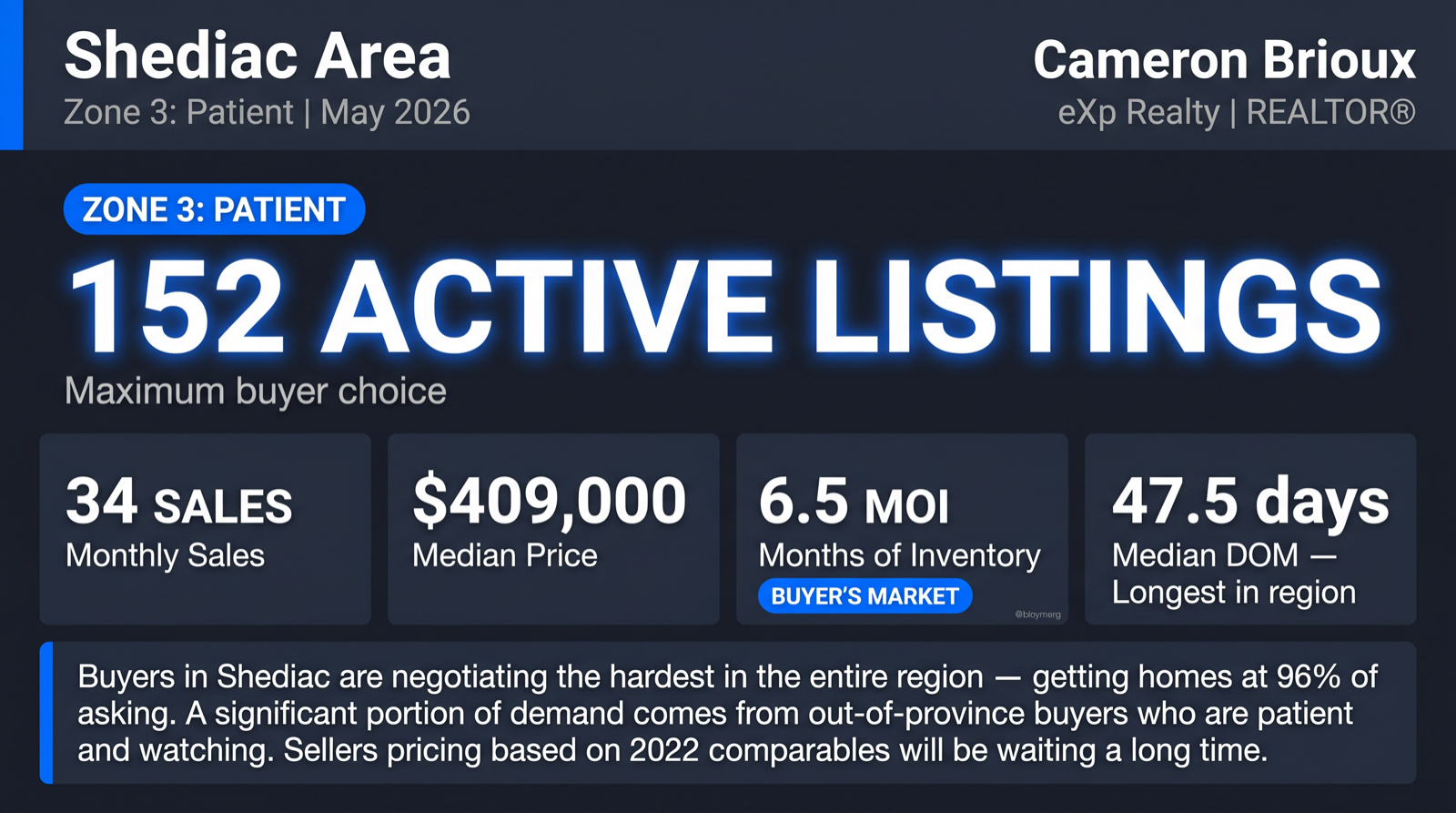
Shediac is the most interesting story in this zone. Buyers in Shediac are negotiating the hardest in the entire region, getting homes at 96 percent of asking price on average. A significant portion of the demand in that market has historically come from out-of-province buyers who discovered Atlantic Canada during the pandemic. That buyer pool is still there, but they are more patient now. They are not panicking. They are watching. And when they find the right property at the right price, they move. But sellers in Shediac who are pricing based on 2022 comparables are going to be waiting a long time.
The Verdict: What This Means For You
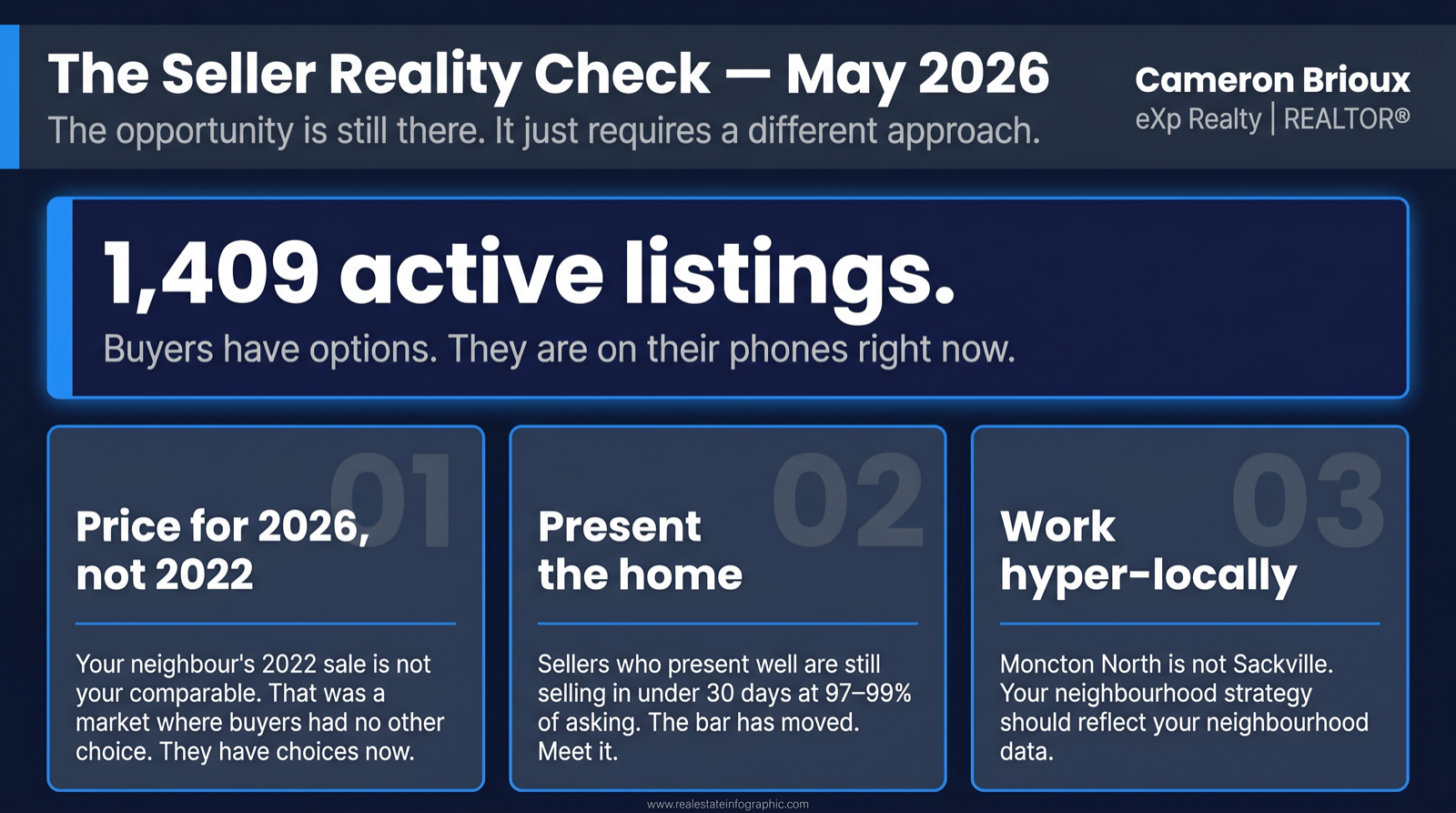
If you are a seller: The days of throwing a number at the wall and seeing what sticks are over. You are competing against 1,409 active listings. That is a real number. That is real competition. And buyers have access to all of it on their phones, in real time. But sellers who price correctly from day one, who present their homes well, who work with someone who understands this market at the neighbourhood level, are still selling. They are selling in under 30 days. They are getting 97 to 99 percent of their asking price. The opportunity is absolutely still there.
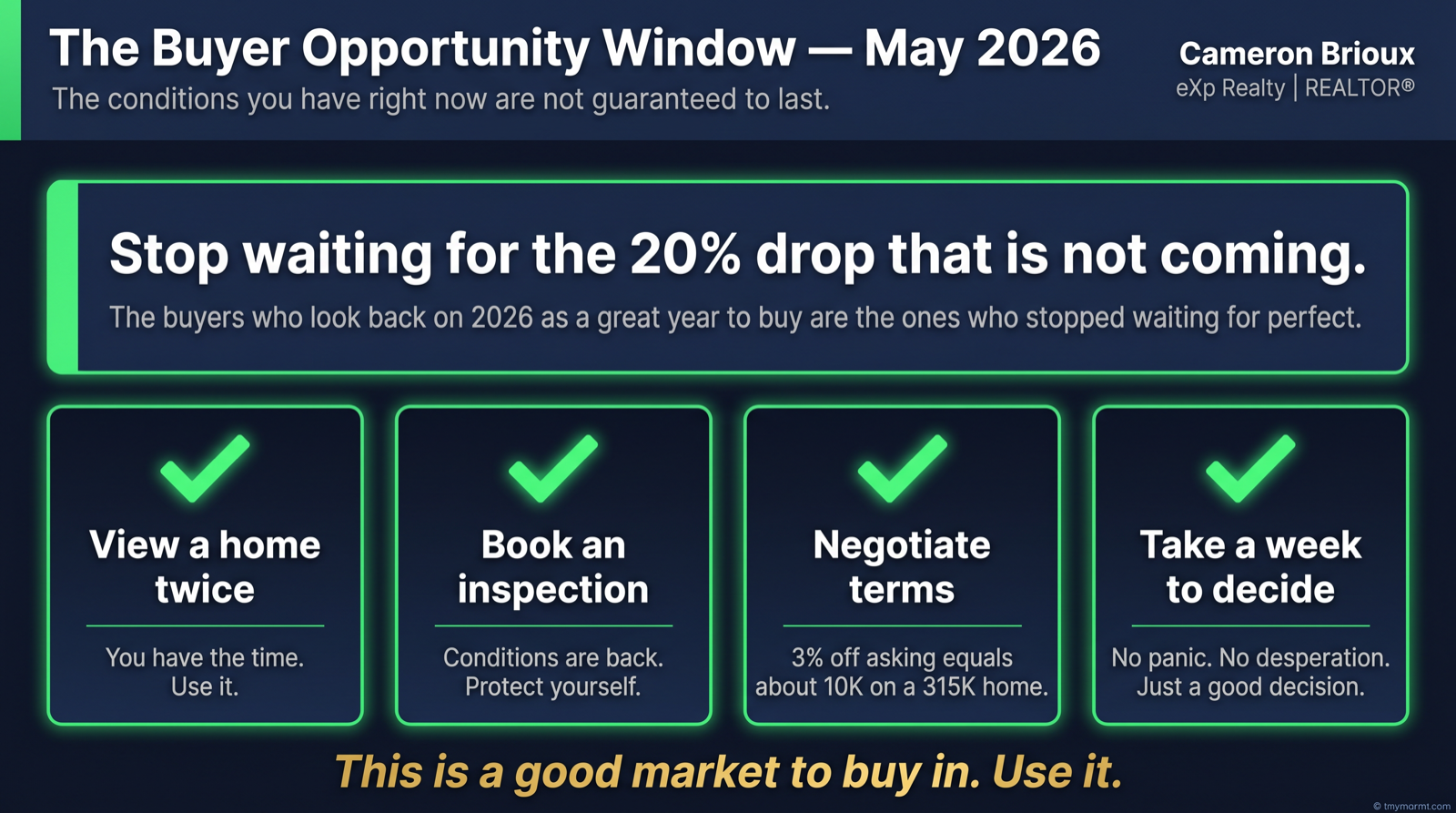
If you are a buyer: Stop waiting for the 20 percent price drop that is not coming. I know that is what some people on the internet are telling you. I know it feels logical, prices went up a lot, so they should come down a lot. But that is not how this market works. Prices are flat. They are not collapsing. And the conditions you have right now, the ability to view a home twice, to book an inspection, to negotiate terms, to take a week to think about it, those conditions are not guaranteed to last forever. The buyers who are going to look back on 2026 as a great year to buy are the ones who stopped waiting for perfect and started moving on good.
Want to Know What Your Home Is Worth in This Market?
The decision you make about your home is probably the biggest financial decision of your life. It deserves better than a headline. Let us look at the actual data for your specific street, your specific property type, and your specific price range. No guessing. No water cooler. Just the numbers.